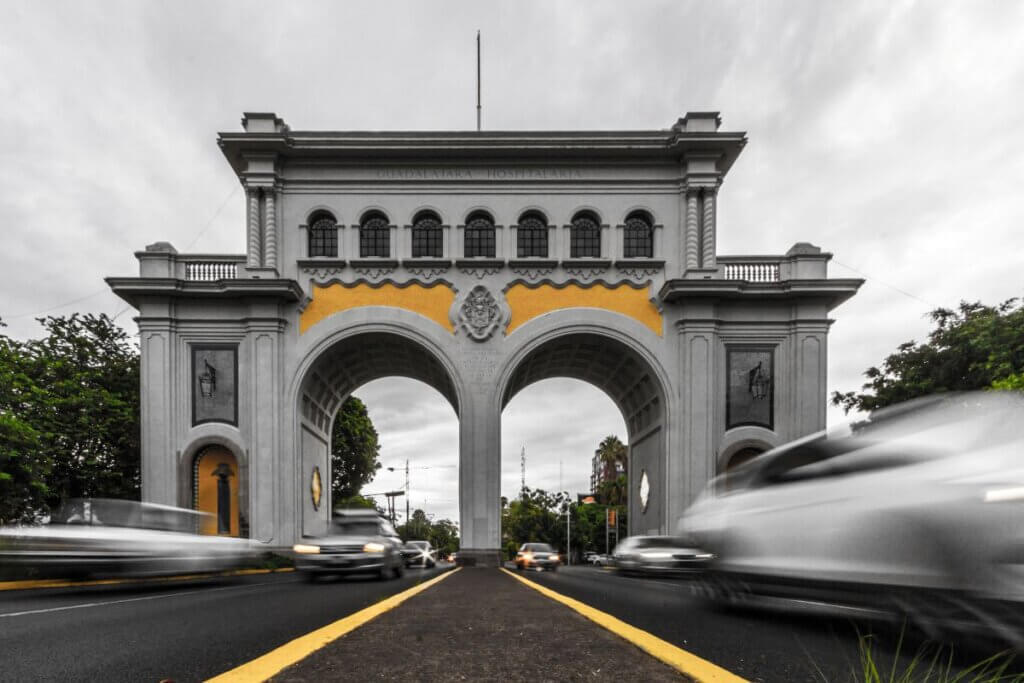
It’s 1983 and I’m standing in the Arrivals area of Guadalajara International Airport in Mexico, heart pounding, disoriented. I’m 20 years old, and completely alone. “Jenni,” I think to myself, “You are definitely NOT in Kansas anymore.”
My arrival in Mexico marked the beginning of a 10-week study abroad experience to supplement my Psychology and Spanish majors. The schooling was organized by my university, but I was in charge of getting myself to Mexico. There were no travel abroad coordinators, no fellow students. . . just me, pulling my beast of a 30-inch hard-sided suitcase with me.
Having survived my first-ever airplane flight, I looked around, took in the throngs of people, and tried to parse out the next steps. I had six years of Spanish instruction under my belt and surely that would be enough to get me to my host family’s house, right? It was then that the Dorothy in Oz moment hit me: nobody was speaking English. Not a single soul. As I made my way to Customs, I had a serious reality check: Huh. You are not at all fluent in Spanish. And I got my first taste of what it’s like to be outside the mainstream because I couldn’t fluently advocate for myself.
Somehow, I found a taxi (first time for that, too) and made my way to the host family’s home. I met my fellow American student roommates and Mexican family, who turned out to be among the most generous souls I’ve ever encountered. We were included in everything. From eating family meals together (with my Mexican father bellowing “La comida!”) to announce mealtime, to watching Mexican soap operas with my host mother, we were part of the family. There, in a comfortable, two-story home, the Garcia family welcomed and patiently cared for me, even as I frequently stumbled to communicate even the most basic requests.
When I reflect on this branching point in my life, it brings to mind the notion of kindness and how little it takes to make someone feel at home, and therefore, safe. Safe to be who they are, safe to take chances. During my time in Mexico, there were abundant chances to stretch outside my comfort zone, to learn, to see the world in a new way. And I did that in spades. Isn’t that what a study abroad program is about?
But it wasn’t until much later, many years after returning to my Midwestern cocoon of support and safety that I realized one of the deeper, more transformative lessons of that Mexican summer in 1983, one that represents a significant branch in my thinking and how I see the world.
I owe my shift in perspective to a bus ride.
To get to and from classes, I needed to take the city bus. Guadalajara is a sprawling city about the size of Chicago. One day, I missed my bus stop and didn’t realize it immediately. I spent the next few stops trying to orient myself and before I knew it, the bus had reached the end of the line. All that remained was me, one other passenger and the bus driver. The driver told me to get off the bus. I tried to explain that I was lost and wasn’t sure how to get myself back home. Was there another bus? He shrugged his shoulders. Not his problem. Please exit my bus, señorita.
I was alone in a large city, miles away from my welcoming and safe Mexican family’s neighborhood. There was no way out except through– just keep on walking and hope that at some point, the landmarks would look familiar. After many blocks of walking, I finally found a cab and get myself home.
For the first time in my life, I couldn’t communicate fluently enough to advocate for myself. The fear and impotence I felt as I pleaded with that bus driver was a first for me. Many years later I see this experience as a lesson in compassion for those who can’t speak fluently for what they need. In the years since graduating college, I’ve met many people for whom English is a second language, and I have several friends whose children have disabilities such as cerebral palsy or autism that render them unable to communicate clearly. That experience gave me a glimpse into how it feels – when people look at you and think that maybe you aren’t as smart as they are because you can’t speak the language . . .or that because you screwed up a simple act like exiting at the proper bus stop, you are careless or worse, ignorant.
My study abroad experience was a pivotal moment in my adult development because it took me so far outside my abilities that I had no choice but to humble myself to it. On balance, I was safe in Mexico because I had a support system of family, friends, and school administrators that provided a safety net. Everyone was kind and understanding towards the rich white girl from the United States. Except for that bus driver, of course. But perhaps he was my greatest teacher of all. Four decades ago, I (literally) walked several miles in someone else’s shoes. And it’s made me a much more compassionate person.
Leave a Reply